Thickness is the first spec worth locking down on a custom bag order, and it is the one buyers most often guess at. Order too thin and the bag splits, leaks, or fails at the seal on the way to a customer. Order too thick and you pay for material and shipping weight the product never needed. The unit that governs all of this is the mil, and understanding it turns a vague “make it sturdy” instruction into a number a converter can quote and print against.
What a mil actually measures
A mil is one thousandth of an inch, written 0.001 inch. It is not a millimeter and it is not a gauge, which is where most confusion starts. For a sense of scale, a human hair runs roughly two to three mils across, so a 2 mil bag wall is about the thickness of a single hair. In metric terms, one mil equals 25.4 microns, so a 3 mil film is about 76 microns, a 5 mil film about 127 microns, and a 7 mil film about 178 microns. If a supplier quotes you in microns, that conversion is all you need.
A separate scale, gauge, still shows up on stretch and shrink films: 100 gauge equals 1 mil, so an 80 gauge pallet wrap is 0.8 mil. Zipper bags, mailers, and pouches are almost always specified in mils in North America, so unless you are buying pallet wrap you can think in mils and ignore gauge entirely. When you approve artwork and a spec sheet, the mil figure should appear next to the bag dimensions and material.
Matching poly bag gauge to the job
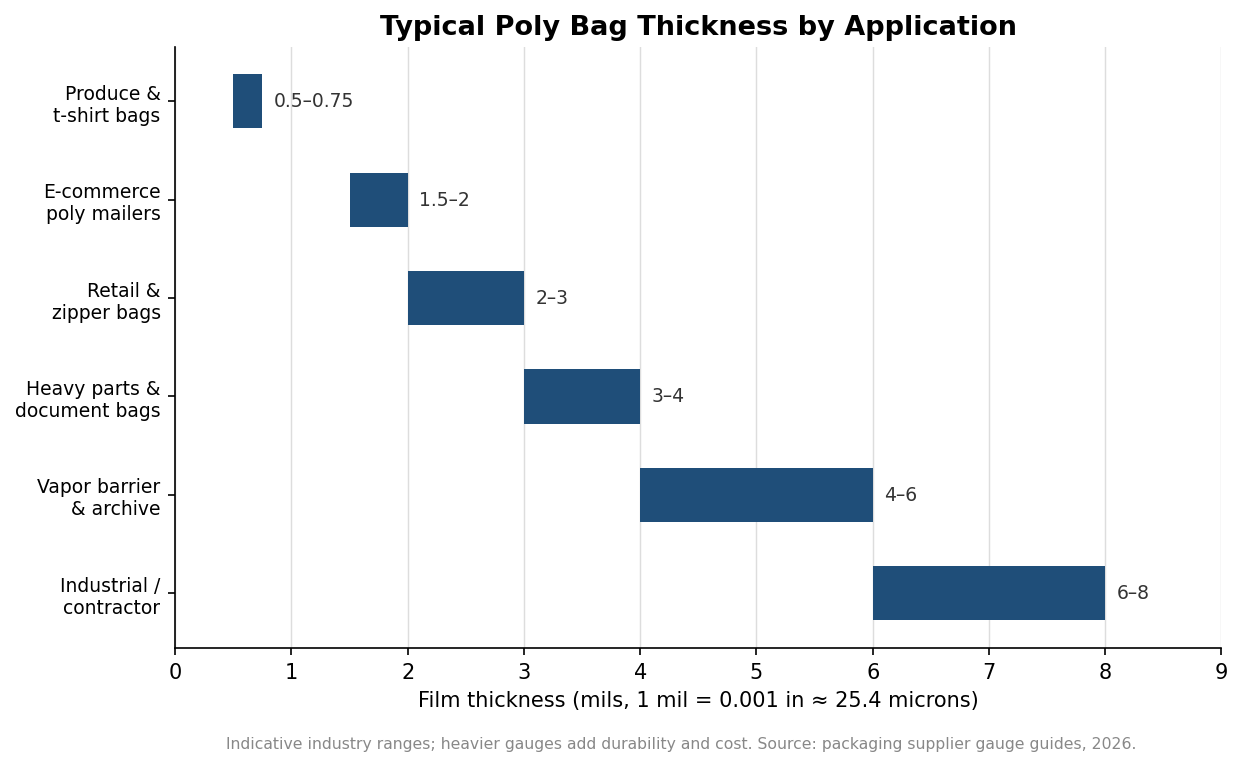
Flat and zippered polyethylene bags cover a wide thickness range, and each band maps to a rough class of use. The lightest films, 0.5 to 0.75 mil, are the disposable tier: produce bags and t-shirt sacks that need to open easily and cost almost nothing, but tear under any real load. Standard e-commerce shipping sits at 1.5 to 2 mil, which is where most poly mailers and light zipper bags land. That gauge holds soft goods, apparel, and small light parts without drama.
Step up to 2 to 3 mil for retail zipper bags and anything a customer will reopen repeatedly, since the thicker wall keeps the track from distorting. 3 to 4 mil is the heavy-parts and document range, resisting punctures from hardware, fasteners, and cornered components. From 4 to 6 mil you are into vapor-barrier and archive territory, and 6 mil and up is industrial and contractor grade. A useful rule from converters is that moving from 2 mil to 3 mil adds only a small amount per bag but a large jump in tear and puncture resistance, so if your product sits near a boundary, rounding up is usually the cheaper mistake.
Weight and edges matter as much as the headline number. A one-pound bag of soft fabric behaves nothing like a one-pound bag of threaded bolts, and the bolts will find the weakest gauge you give them. When you brief a supplier, describe the contents, the sharpest edge inside, and how the bag will be handled, not just a target mil, so the recommendation accounts for the real failure mode.
Mylar and foil-laminate bags: thickness plus barrier
Mylar bags are where thickness stops telling the whole story. A true mylar bag is a laminate structure, often polyester bonded to a layer of aluminum foil and a food-safe sealant, and the foil layer is what blocks light and oxygen rather than the raw thickness. Two bags can both read 5 mil while one is a clear metallized film and the other a genuine foil laminate with a far tighter barrier. Ask what the layers are, not only how thick the wall is.
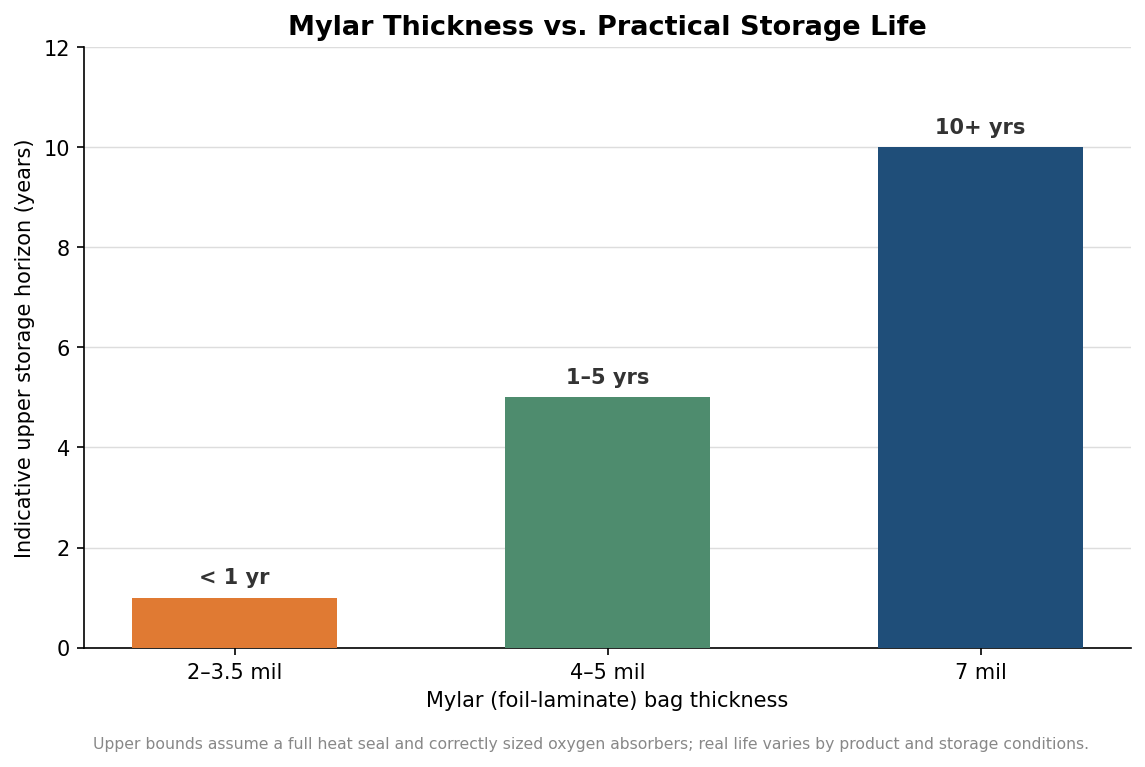
Within genuine foil-laminate mylar, thickness still tracks with durability and practical shelf life. 2 to 3.5 mil suits light, dry, short-horizon items such as snacks, powders, and small parts. 4 to 5 mil is the most common food range and handles grains, beans, and pasta for medium-term storage. 7 mil adds meaningful puncture resistance and is the usual choice for long-term storage and emergency supplies, while 10 mil and above is reserved for industrial and bulk handling where the bag takes rough treatment. The storage horizons below are indicative upper bounds, and they assume the bag is fully heat sealed and packed with correctly sized oxygen absorbers; a beautiful 7 mil bag left partially open will not outlast a well-sealed 4 mil one.
Barrier performance is measured by oxygen transmission rate and water vapor transmission rate, and a well-made foil laminate drives both close to zero, which is why it can protect contents for years. Clear and lightly metallized films sit higher on both measures and are better thought of as medium-barrier packaging. Those transmission figures vary by exact film construction, so treat any single number you see online as a ballpark rather than a guarantee, and ask your supplier for the spec on the specific material you are buying.
How thickness interacts with printing, sealing, and cost
Gauge choice ripples into three other parts of the job. On sealing, a heavier wall gives the heat sealer more material to fuse, which generally means a more forgiving and reliable seal, especially on filled bags run at speed. On printing, a stiffer, thicker film tracks more predictably through a press and resists the wrinkling that can distort artwork on very thin stock, though any reputable converter prints clean work across the normal range. On cost, thickness is close to linear with material used, and material drives both unit price and shipping weight, so a needless jump from 3 mil to 5 mil across a large run is real money for protection you may not use.
The goal is not the thickest possible bag, it is the thinnest gauge that survives your product, your fill method, and your shipping path with margin to spare. When you request a quote, state the bag style and size, the contents and their sharpest edges, whether the bag is reclosed by customers, the barrier you need if it is food or moisture sensitive, and the run quantity. With those in hand a supplier can recommend a specific mil and material rather than guessing, and you can compare quotes on equal terms instead of comparing a 2 mil price against a 4 mil one and wondering why they differ.
Leave a Reply