The closure is the part of a resealable bag a customer touches every single time they use it, and it is where a lot of packaging decisions quietly go wrong. Pick a press-to-close zipper for a heavy powder and shoppers will fight it; pay for a slider on a spice pouch and you have spent money the product did not need. The good news is that the choices are finite and each one has a clear job. This is a side-by-side look at the common closures so you can match the mechanism to the product instead of defaulting to whatever the last order used.
Press-to-close: the economical default
The press-to-close zipper, the familiar interlocking rib-and-groove profile, is the standard closure for most food and household pouches, and for good reason. It is inexpensive to add, it is intuitive, and on a single-track profile it seals well enough for spices, snacks, frozen foods, and processed meats. Its weakness is human: people tend to press the middle first and work outward, which traps a pocket of air and leaves the ends unsealed. A double-track version, two parallel ribs instead of one, meaningfully improves that by giving a second line of defense and a more definite closed feel. Some profiles add an audible click so the user gets confirmation the bag is shut. If your product is forgiving about a not-quite-perfect reseal, press-to-close is almost always the right call and the cheapest one.
Slider: paying for a guaranteed close
A slider zipper puts a small plastic tab over the tracks that forces them together edge to edge as it travels. That solves the press-to-close air-gap problem, because the closure cannot be sealed in the middle only, and it is markedly easier for anyone with limited hand strength or a large, heavy bag to manage one-handed. That ease is why sliders show up on pet food, bulk protein powders, pool chemicals, and other pourable or heavy products where a clean, complete reseal actually matters. It is the premium option: the slider is a separate molded component, so it costs more per unit than a simple extruded zipper, and reclosability of this quality tends to command a shelf premium that buyers in those categories are willing to pay.
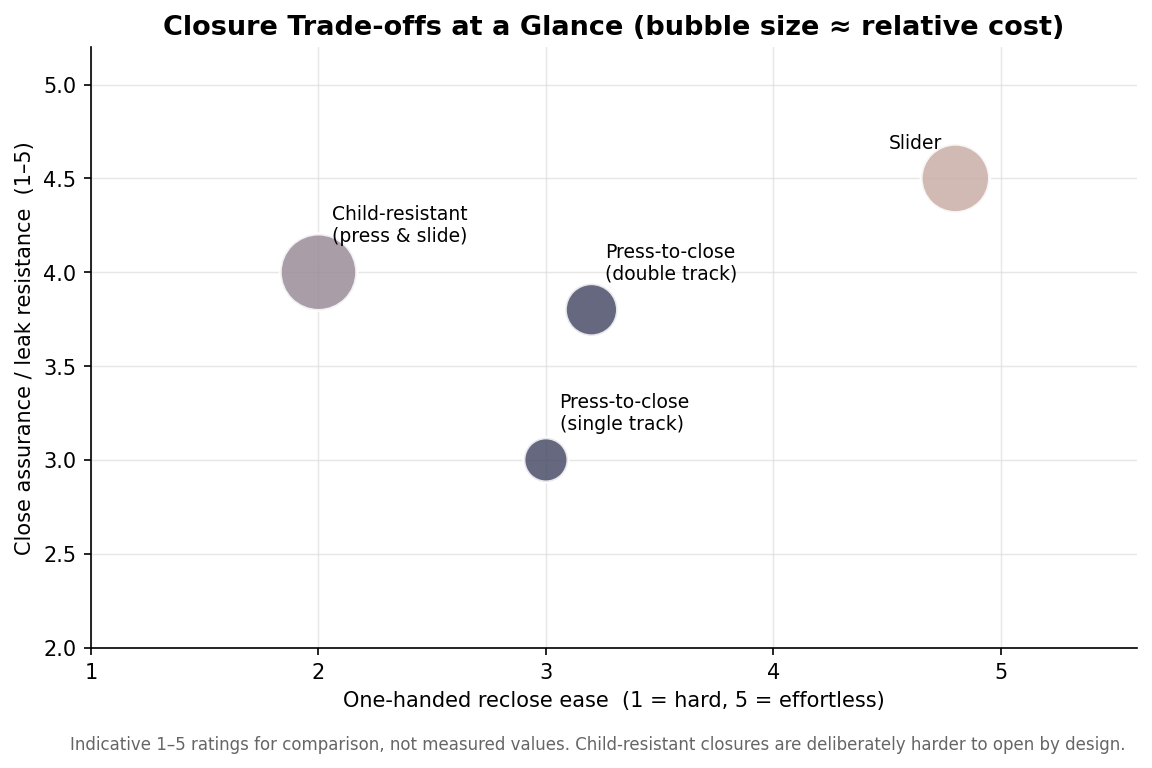
The scatter below frames the trade-off. Sliders sit in the easy-and-secure corner at a higher cost; single-track press-to-close is cheap but middling on both counts; double-track press-to-close is the sensible middle. Child-resistant closures deliberately sit low on ease, which is the whole point of them.
Tear notches: tamper evidence for almost nothing
A tear notch is a small pre-cut V or U shape at the top edge that gives a clean starting point for opening the bag by hand. It does two useful things at once: it makes first opening easy without scissors, and because the top has to be torn away, it acts as a simple tamper-evident signal that the pack has not been opened before. It costs almost nothing to add. The detail that matters is placement, because the notch has to sit in the sealed area above the zipper without cutting into the tracks; a common target is roughly six to twelve millimeters above the zipper profile. Laser cutting gives a cleaner, more reliable tear than mechanical die cutting, especially on thicker laminates, and a clean tear is what keeps the notch from wandering across the face of the bag.
Hang holes, child resistance, and recyclable zippers
Three more features are situational rather than universal. A hang hole, usually the oblong “euro” or butterfly slot, lets a pouch hang on a retail peg. It needs a fully sealed border around the cut so the bag does not leak or delaminate at the hole, and it adds minor tooling cost. If you are selling purely online, you can skip it and save the tooling entirely. Child-resistant closures, typically a press-and-slide mechanism, are a different world: where they are required, for cannabis edibles and certain household chemicals, they must be certified to a recognized standard such as ASTM D3475 under the U.S. Poison Prevention Packaging Act, and that certification, not the look of the zipper, is what makes the pack compliant. Finally, recyclable mono-material zippers match the closure to a single-material film so the whole pouch can be recycled together; they cost noticeably more than a standard zipper today but are increasingly expected, and in some regions required.
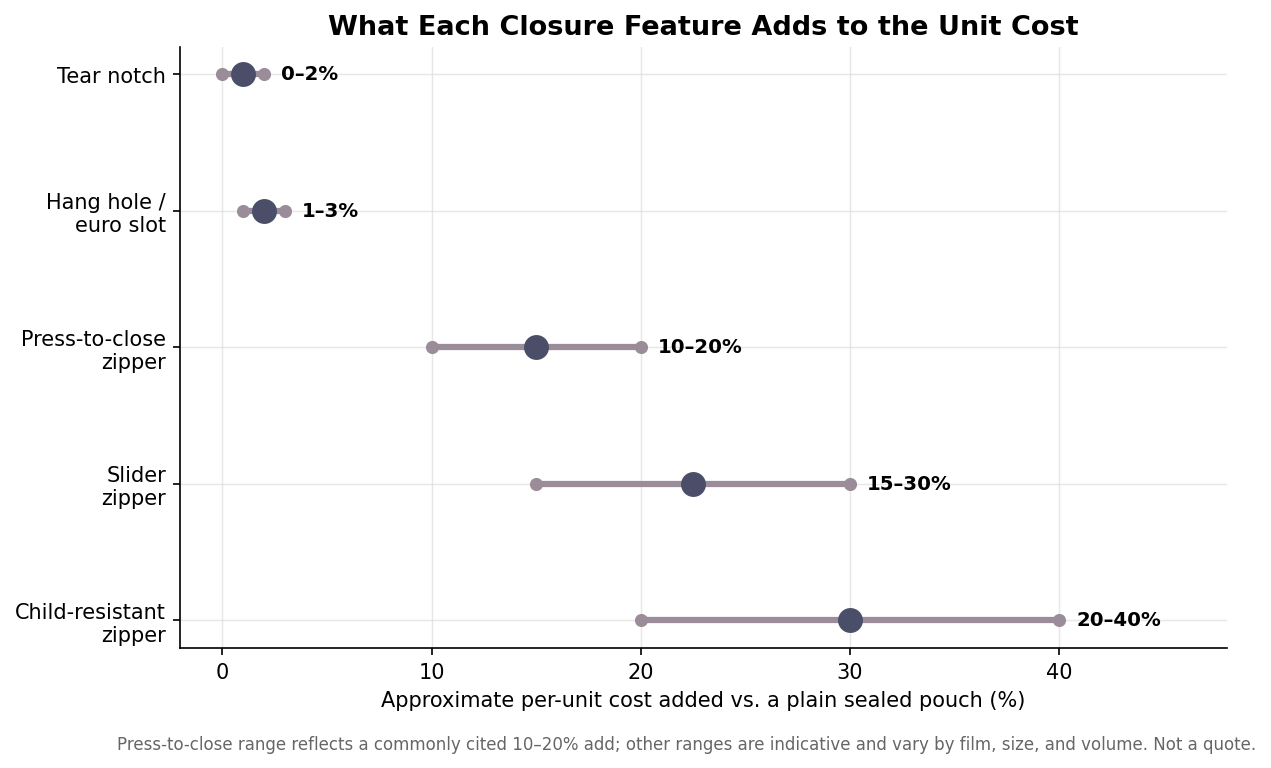
Because every one of these choices moves the unit price, it helps to see them on one scale. The chart below shows the approximate cost each adds relative to a plain sealed pouch. Notches and hang holes are rounding errors; the zipper is the real line item, and child resistance is the most expensive closure decision you can make.
Matching the closure to the product
Work backward from how the product is used. If it is light, opened occasionally, and not fussy about an airtight reseal, a single-track press-to-close zipper with a tear notch covers it cheaply and looks retail-ready. If it is heavy, pourable, or something a customer reseals daily, the slider earns its premium by guaranteeing the close and sparing their hands. If the pouch will hang on a peg wall, add the euro slot and confirm the seal fully surrounds it; if it ships in a box, leave the slot off. And if the contents fall under child-resistant rules, that requirement outranks every convenience consideration, so start from a certified closure and design the rest of the bag around it. Settle those questions before artwork, because the closure changes the top-seal geometry, and put the zipper type, the notch placement, and any hang-hole or compliance requirement in the written spec so the sample you approve is the pouch that ships.
Leave a Reply