Die-cut mylar bags look simple, which is exactly why so many first orders disappoint. The format pairs a high-barrier metallized pouch with a punched-out carry handle, and it has become a favorite for retail coffee, pet treats, supplements, and specialty foods because it hangs on a peg, carries like a handbag, and protects the product inside. But the same order can go wrong in four predictable ways, and each one is avoidable if you specify the bag properly up front. This guide walks through the mistakes that cost brands a reprint, so your first run is the one you actually sell.
The figures below reflect industry norms and are indicative rather than absolute; barrier performance and durability depend on the specific film laminate and construction your supplier uses, so treat these as a framework for the questions to ask, and confirm the details against a physical sample.
Mistake one: treating the die-cut handle as decoration
The punched handle is a structural feature, not a graphic. When a filled bag hangs from that opening, the entire product weight concentrates on a small arc of film, and a handle cut into thin, unreinforced material will tear on the first lift. Well-made die-cut bags reinforce the handle area, typically with an additional laminated patch or a thicker panel at the top, so the load spreads instead of concentrating on a single edge. When you brief a supplier, ask specifically how the handle is reinforced and what filled weight it is rated to carry, and place the handle high enough above the product fill line that it does not distort the pouch when hung. A handle that looks clean in the artwork but is cut into a 2.5 mil unreinforced film is the single most common reason these bags fail in a store.
Mistake two: underspecifying the film thickness
Thickness in flexible packaging is measured in mils (thousandths of an inch), and choosing too thin to save a fraction of a cent per bag is a false economy for a handled pouch. As a rough map, 2.5 mil (about 63 microns) suits lightweight dry goods like snacks and tea or inner liner layers, but is vulnerable to punctures. Around 3.5 to 5 mil handles powders and most retail products. 5 mil (about 127 microns) is the most common commercial thickness, balancing strength, barrier, and cost, and is the sensible default for coffee, supplements, and everyday retail. 6 to 7 mil (up to about 178 microns) is heavy-duty territory for bulk, sharp-edged, or long-storage products.
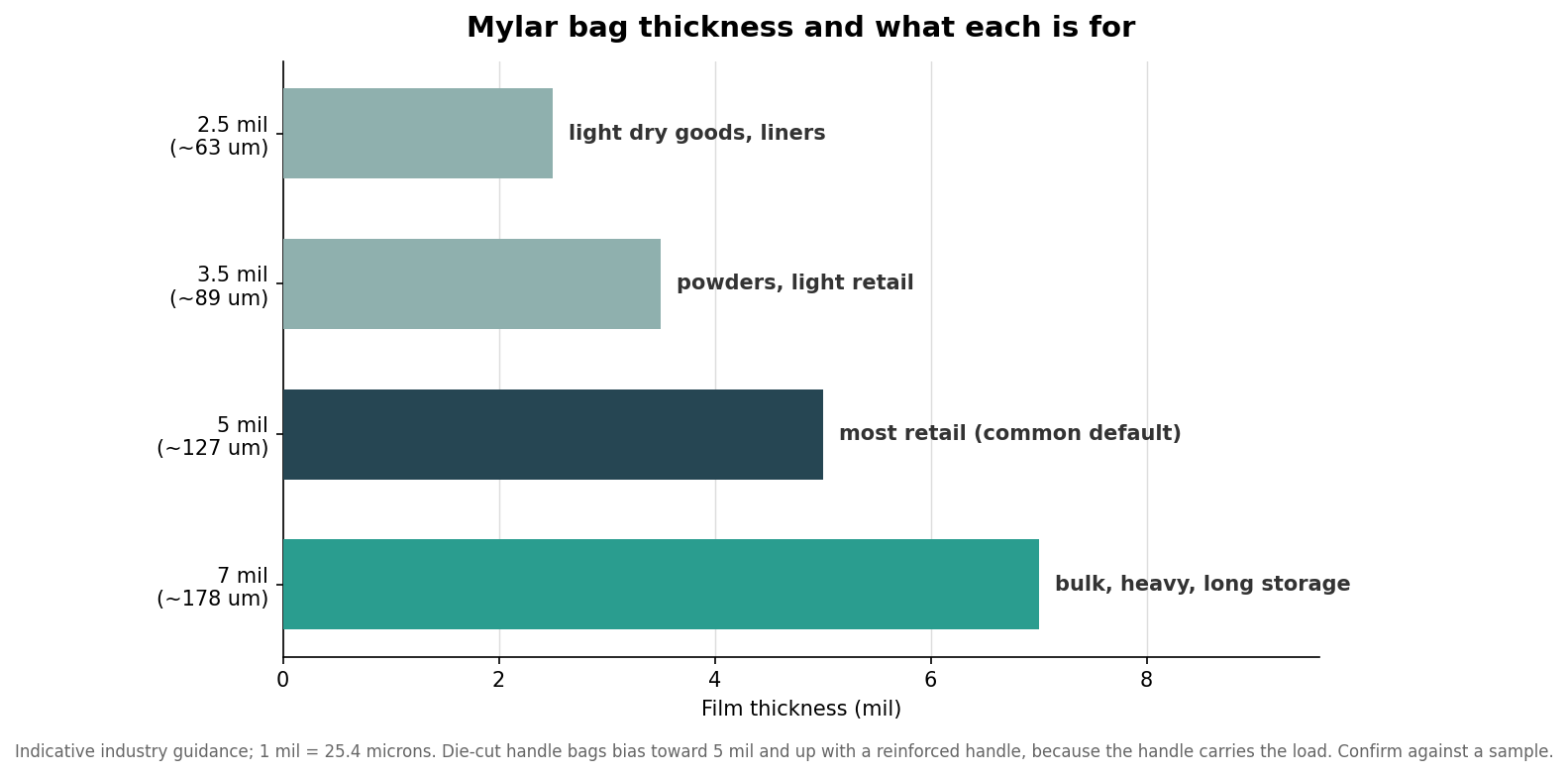
For a die-cut handle bag specifically, bias upward. Because the handle bears load, a heavier gauge, generally in the 5 mil range or above with a reinforced handle, gives the tear resistance a hanging bag needs; a thickness that would be fine for a flat, shelved pouch can be marginal once you add a handle and gravity. The guiding principle from the packaging world holds: the goal is not the thickest possible film but the thickness that matches the real application, and a handled retail bag is a more demanding application than a plain one.
Mistake three: assuming all “mylar” barrier is equal
“Mylar” gets used loosely, but the barrier performance behind that word varies by orders of magnitude depending on the film structure, and this is what actually protects flavor, freshness, and shelf life. Oxygen transmission rate, or OTR, measures how much oxygen passes through a film; lower is better. Plain LDPE poly is highly permeable, on the order of 7,000 to 8,500 cc/m² per day at a 1 mil reference. Polyester (PET) is far better at roughly 31 to 93. A metallized PET laminate, which is what most retail “mylar” bags actually are, drops to roughly 0.16 to 1.7, and a full aluminum-foil laminate approaches a near-total oxygen barrier.
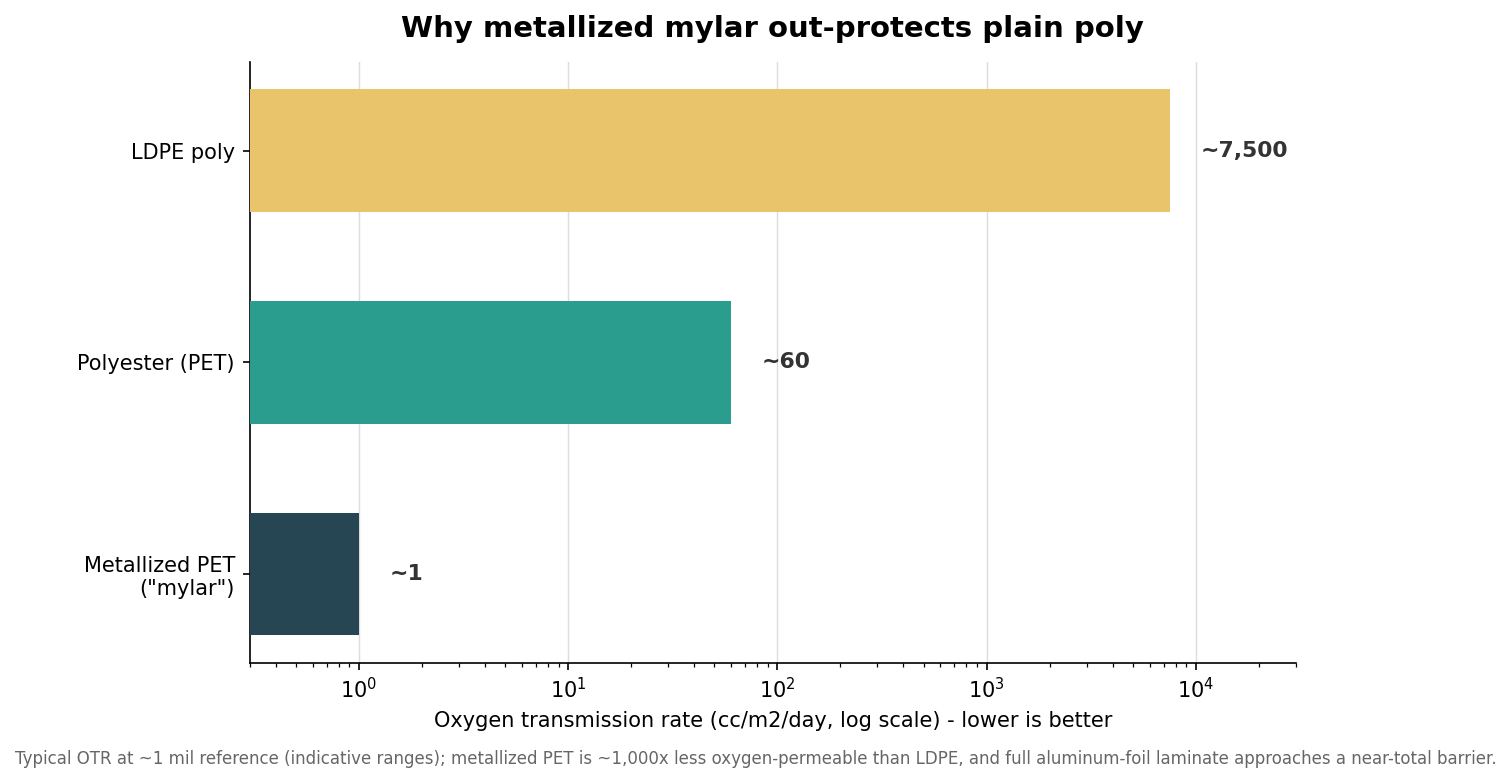
The practical takeaway is that a printed poly bag and a metallized mylar bag are not interchangeable even if they look similar on the shelf. If your product is oxygen- or moisture-sensitive, coffee, roasted nuts, supplements, anything with volatile aroma, specify a metallized or foil laminate and confirm the OTR and moisture rating with your supplier rather than trusting the label “mylar.” If the product is shelf-stable and short-cycle, a lighter barrier may be fine and cheaper. Match the barrier to the product’s actual sensitivity, not to a marketing term.
Mistake four: leaving the seal, finish, and artwork to chance
Three smaller decisions round out the specification. The reseal feature should match how the customer uses the product: a press-to-close zipper suits frequent reopening, while a simple tear-notch above a sealed top suits single-use portions; a hang-handle bag intended for repeat use almost always wants a reliable zipper below the handle. The finish shapes perception and cost, with matte reading premium and hiding handling marks, gloss adding pop, and a clear window letting the product sell itself, each at a different price point. Finally, prepare artwork for the reality of the format: keep critical logos and text clear of the handle cut-out and the bottom gusset where the film folds, build in bleed, and specify brand colors as defined Pantone values so they hold across the metallized surface, which can shift color differently than white film.
Pulling it together, a die-cut mylar bag is a strong retail format when the four specifications line up: a reinforced handle rated to the filled weight, a film thickness matched to that load (commonly 5 mil or more), a barrier laminate matched to the product’s sensitivity, and a seal, finish, and layout designed around the handle and gusset. On cost, expect unit price to rise with thickness, barrier laminate, special finishes, and lower order quantities, and to fall as volume grows; treat any quoted range as indicative and quantity-dependent. Specify those four things deliberately and the bag protects the product, carries reliably, and looks the way you designed it, which is the whole point of ordering custom in the first place.
Leave a Reply