“Food-safe” is not something you can tell by looking at a bag. A clear resealable pouch that feels identical to a food-grade one may be made from a different resin, colored with a different pigment, or printed with an ink that was never cleared for food contact. When the product going inside is something people eat, the safety of the packaging is a documented property, not a visual one, and knowing what to check protects both your customers and your brand. This guide explains the framework in plain terms so you can specify and verify a food-contact bag with confidence.
A note before the specifics: what follows is general information about how food-contact packaging is regulated in the United States, not legal or regulatory advice. Requirements depend on the exact food, temperature, and use, so treat this as a way to ask better questions and confirm the details with your supplier and, where the stakes are high, a qualified regulatory expert.
“FDA compliant,” not “FDA approved”
The single most common misunderstanding is the phrase “FDA approved.” For food-contact plastics, the FDA does not approve individual bags or films the way it approves a drug or a medical device. Instead, it publishes the rules that materials must meet, and manufacturers are responsible for ensuring their products comply. The accurate term is FDA compliant, meaning the material meets the standards set out in Title 21 of the Code of Federal Regulations. Those rules for food-contact materials sit broadly across 21 CFR Parts 170 through 199, with Part 177 covering polymers such as the polyethylene most resealable bags are made from.
So if a supplier tells you a bag is “FDA approved,” it is worth a gentle follow-up. What you actually want to hear is that the film, and everything on it, complies with the relevant CFR sections for your intended food contact, and that they can put that in writing.
What actually has to be food-grade
Compliance is not just about the base plastic. Three things all have to be right. First is the film resin itself: the most common food-contact bag materials are low-density polyethylene, marked with resin identification code #4, along with high-density polyethylene (#2) and polypropylene (#5), with PET (#1) common in laminates. Resins to be cautious with for food are PVC (#3) and the catch-all #7, which can include polycarbonate associated with BPA.
Second are the additives and colorants. Slip agents, anti-block agents, and pigments must themselves be cleared for food contact; a resin that is compliant in its natural state can be compromised by a colorant that is not. Third is the printing. Inks are typically kept on the outside of the bag or separated from the food by the film, and food-contact structures should use inks suited to that purpose. Finally, recycled content is its own question: post-consumer recycled resin needs its own clearance for food contact rather than inheriting the status of virgin food-grade material, so do not assume a recycled bag is automatically food-safe.
Heat, fat, and acid drive migration
The reason compliance is tied to intended use is a process called migration, where tiny amounts of substances move from the packaging into the food. How much migrates depends on the conditions. Heat is the biggest accelerant: warm or hot-fill contents push far more than a room-temperature or frozen product, which is why the service-temperature limit of the resin matters. Fatty and acidic foods are also more aggressive than dry goods, drawing out more from the same film.
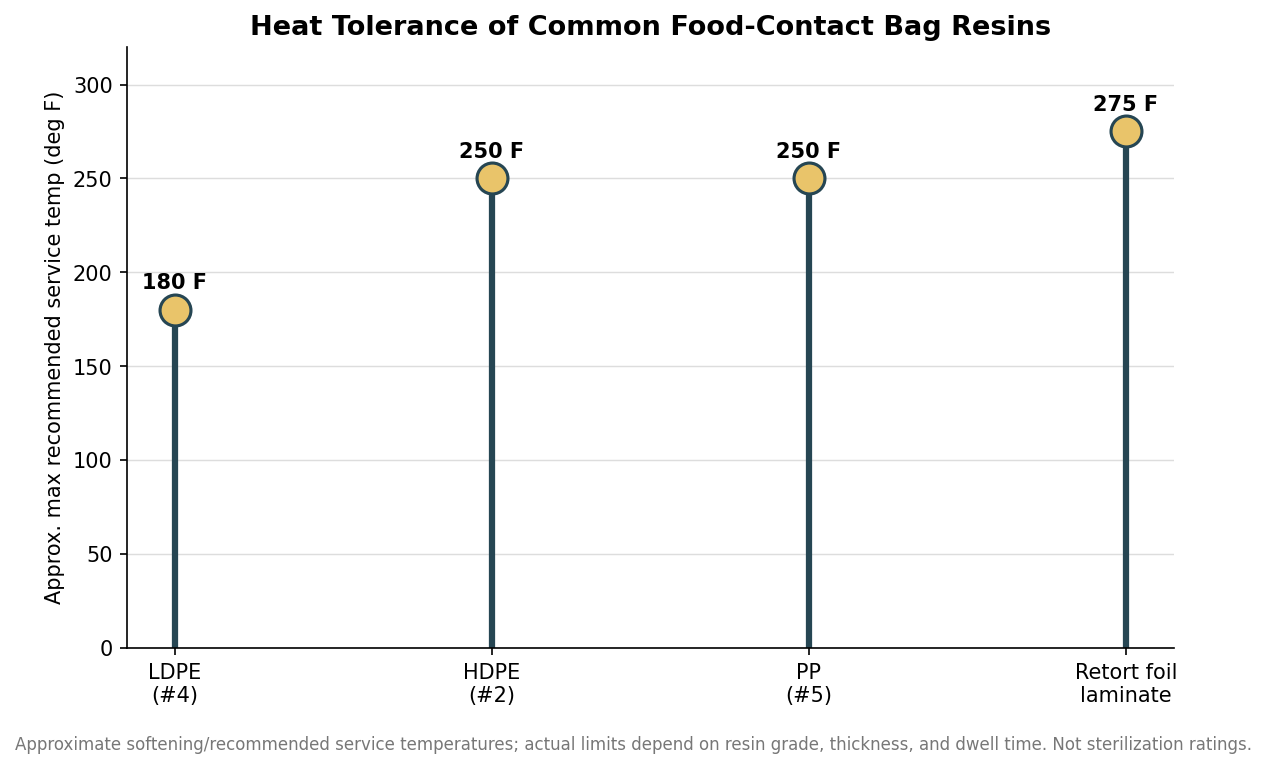
That makes temperature tolerance a practical screening tool. Low-density polyethylene softens at a relatively low temperature and suits cold and dry applications, while polypropylene and high-density polyethylene tolerate more heat, and retort-grade foil laminates are built for sterilization-level temperatures. The chart below shows approximate service temperatures for common bag resins; match the bag to the hottest condition the food will ever see, including filling and any reheating.
Barrier is part of keeping food safe
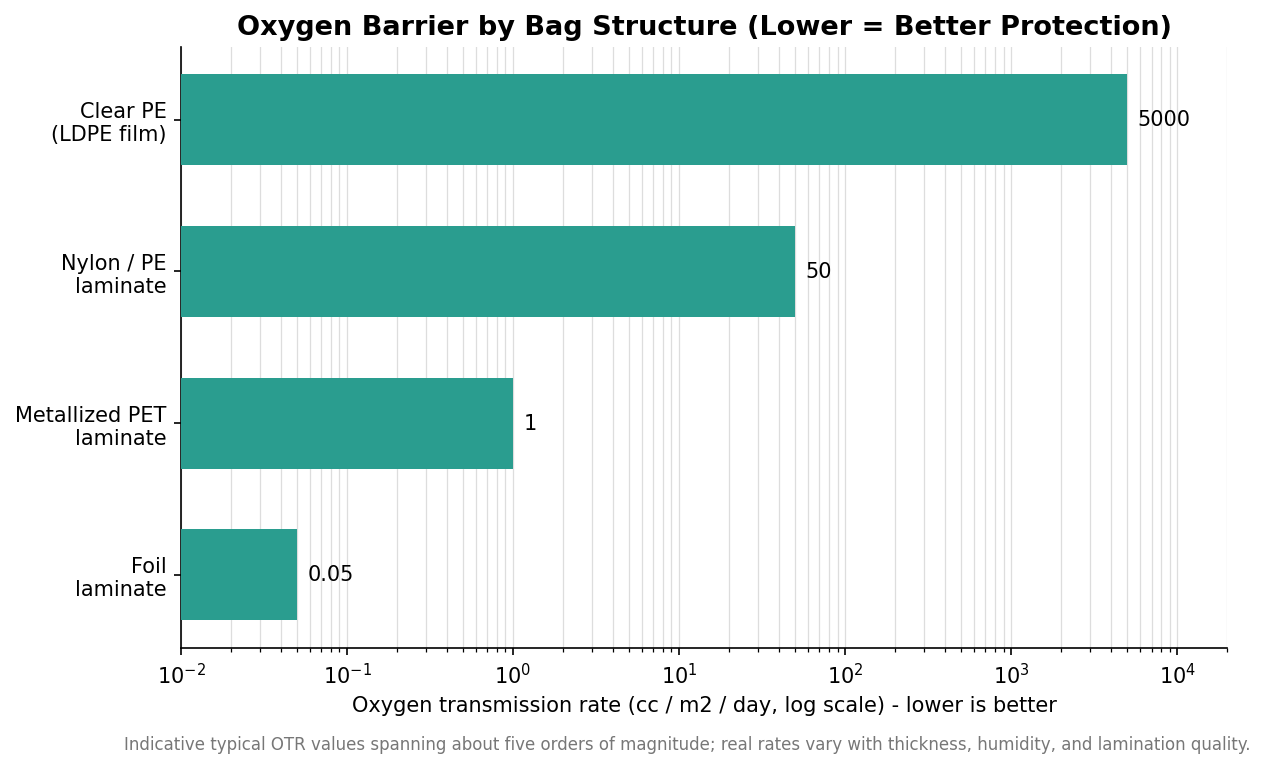
Food safety is not only about what the bag might add to the food; it is also about what the bag keeps out. Oxygen drives rancidity in fats and oils, dulls flavor, and shortens shelf life, so the barrier of the structure is a real food-quality decision. A plain clear polyethylene bag lets a great deal of oxygen through, which is fine for a product eaten quickly but poor for anything meant to sit on a shelf for months.
Laminated structures change that dramatically. Adding a nylon layer, a metallized film, or an aluminum foil layer drops the oxygen transmission rate by orders of magnitude, as the chart below shows on a logarithmic scale. The trade-off is cost, and often the loss of a clear window, so the right barrier is the one matched to the product’s shelf life rather than the strongest one available.
The documentation to ask for
The way you verify all of this is on paper. Ask your supplier for a food-contact compliance statement, sometimes called a Letter of Guaranty or a certificate of compliance, that states the material meets the applicable 21 CFR requirements for your intended use. A thorough supplier can usually reference the specific CFR sections, confirm that colorants and any printing are food-contact compliant, and address common buyer questions such as BPA content or California Proposition 65 where relevant.
Keep that documentation on file, and be specific when you request it: tell the supplier what food will touch the bag and at what temperature, because a statement written for dry snacks may not cover a hot-filled or high-fat product. Getting the paperwork right at the quoting stage costs nothing and gives you a clear record; discovering a gap after the bags are printed and filled is a far more expensive place to find out.
Leave a Reply