A resealable zipper only helps if the film it is welded to actually blocks what degrades your product. Two bags can look identical on a shelf and protect their contents completely differently, because the difference lives in the film’s barrier to oxygen, moisture, and light, not in the closure. If you are packing anything that goes stale, rusts, absorbs humidity, or fades, the barrier spec is the number that decides shelf life. Here is how to read it and match it to what you are selling.
Oxygen is usually the first enemy
Oxygen drives rancidity in fats, dulls flavors, corrodes metal parts, and feeds the microbes that spoil food. Packaging films are rated by oxygen transmission rate (OTR), the volume of oxygen that passes through a set area of film in a day, measured in cc/m²/day at a standard 23°C and 0% relative humidity. Lower is better. A common industry line is that a film counts as a high oxygen barrier below about 1 cc per 100 square inches per day, which works out to roughly 15 cc/m²/day; films in the 1–10 cc/m²/day band are moderate barriers suited to shorter shelf lives.
The spread between materials is enormous, several orders of magnitude, which is why the choice of film matters more than almost any other decision you will make on the order.
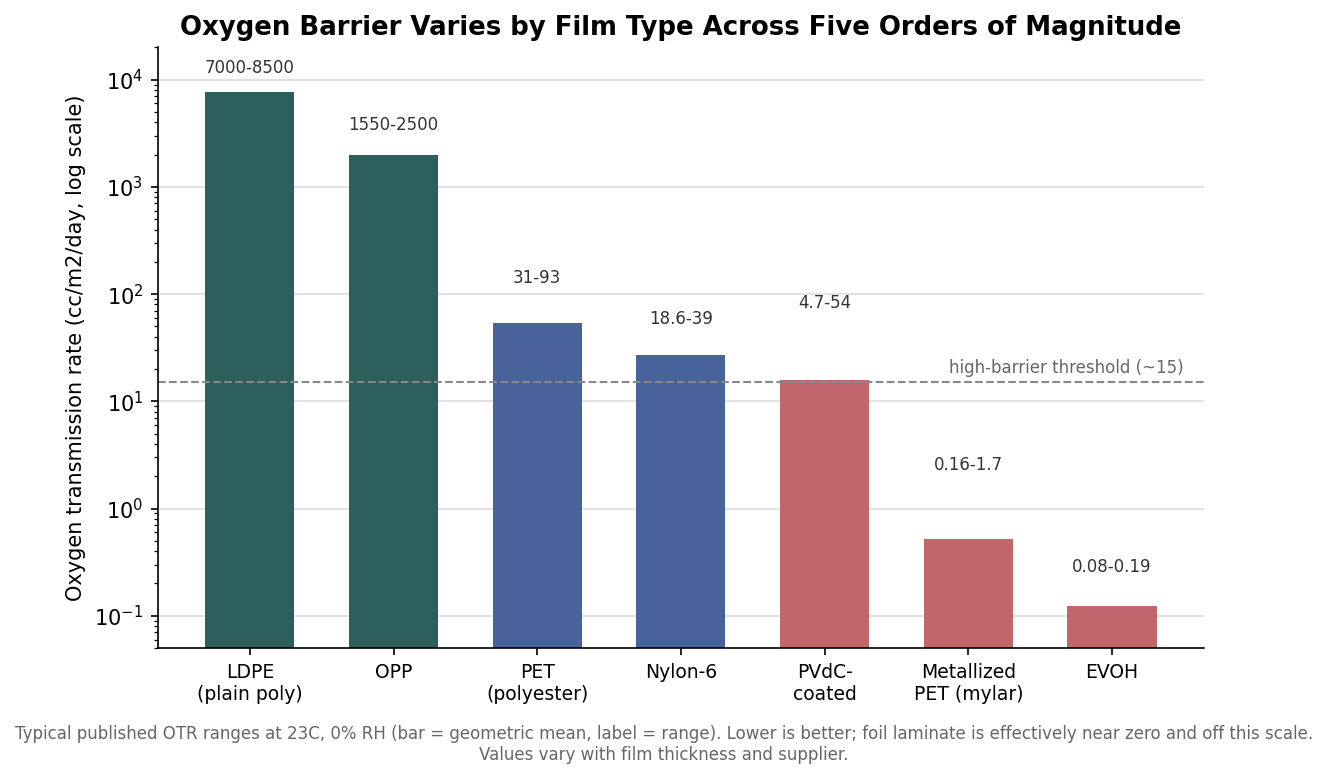
Plain polyethylene, the material of an ordinary poly zip bag, sits at the high-OTR end near several thousand cc/m²/day: fine for parts, hardware, or anything you will use quickly, but not a barrier in any meaningful sense. Metallized polyester, the shiny mylar-style film, and EVOH-containing structures sit at the opposite end, well under 1 cc/m²/day, which is what makes them suitable for long-term food storage. Clear polyester and nylon land in the middle. If oxygen sensitivity is your problem, that chart is the short version of the whole decision.
Moisture is the second, and it is measured separately
A film can be a good oxygen barrier and a poor moisture barrier, or the reverse, so a second spec, the moisture vapor transmission rate (MVTR), tracks water vapor in grams per square meter per day, typically tested at around 38°C and 90% humidity. Dry foods, powders, supplements, and anything that cakes or clumps need a low MVTR; electronics and metal parts need it to prevent condensation and corrosion. Foil laminates are the strongest performers on oxygen and moisture at once, which is why they dominate long-shelf-life and pharmaceutical packaging, while a single-layer poly bag offers little resistance to either. When a supplier says a bag is a barrier bag, ask which barrier they mean, because the two numbers move independently.
Humidity also changes how some films behave in service. Nylon, for instance, is a respectable oxygen barrier when dry but loses ground as it takes on moisture, so a spec quoted at 0% humidity can overstate real-world performance in a damp warehouse or a humid climate. If your product ships into variable conditions, ask whether the OTR was measured dry or at elevated humidity, and lean toward metallized or foil structures whose barrier holds up regardless of the surrounding air.
Light matters more than people expect
Ultraviolet and visible light degrade oils, vitamins, pigments, and many active ingredients, and no amount of oxygen barrier fixes a bag that lets light through. This is where film thickness and opacity come in. A thin, translucent bag lets light reach the contents; an opaque metallized or foil structure blocks it. For resealable mylar-type bags, thickness in mils is the practical proxy people use to gauge light and puncture protection.
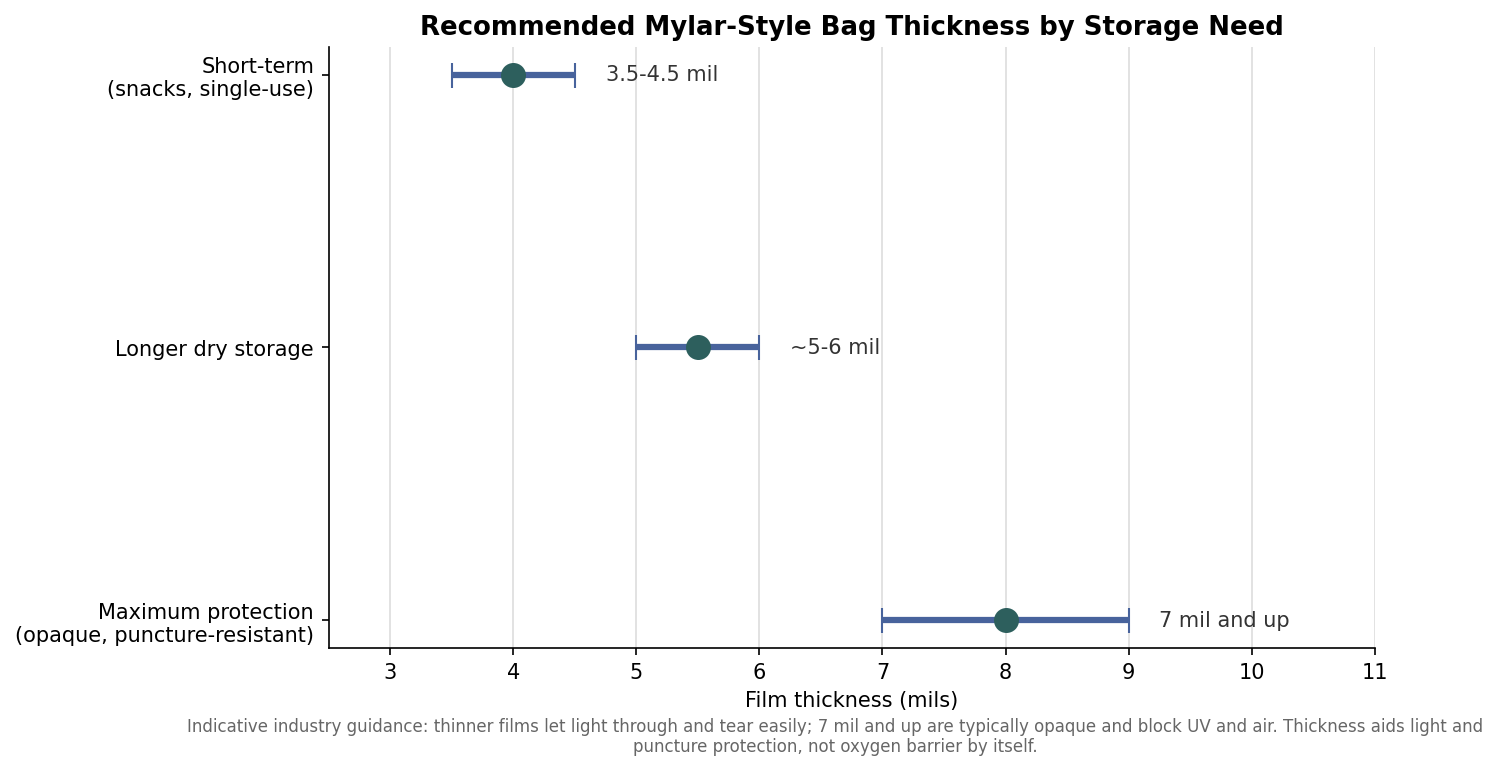
Thinner gauges in the roughly 3.5 to 4.5 mil range are genuinely short-term: they tear easily, let some light through, and are best for snacks or single-use portions. Around 5 mil the film gets meaningfully more protective for dry goods, and at 7 mil and up the bag is typically fully opaque, blocks UV and air far more effectively, and resists punctures well enough for dense, sharp-edged contents. Thickness is not the same thing as barrier, since a thick clear poly bag is still a weak oxygen barrier, but within a given high-barrier film family more mils generally means more light protection and durability.
Match the spec to the product, then add the closure
Work from what actually spoils your product. For oxygen-sensitive food meant to last, specify a metallized or foil structure with a stated OTR well under 1 cc/m²/day, choose a thicker gauge for opacity and puncture resistance, and pair it with an oxygen absorber sized to the headspace. For dry retail goods that turn over in weeks, a moderate-barrier film is often enough and costs less. For hardware, parts, or electronics, prioritize moisture and puncture resistance over oxygen, and consider anti-static or foil films where corrosion or static discharge is a risk. Only after the film is right does the closure choice, whether press-to-close, slider, or tamper-evident, come into play, because a perfect zipper on a leaky film protects nothing.
Ask for the numbers, not the label
When you request quotes, ask for the film’s OTR and MVTR with the test conditions attached, not just a marketing phrase like high barrier, and confirm the gauge in mils. Two suppliers can both call their product a barrier bag and mean very different things, and the gap between them can be a thousandfold on oxygen alone. The numbers are how you tell them apart before you commit to a print run and a year of inventory. Get them in writing on the quote, match them to the shelf life you actually need, and the closure, the print, and the size become the easy decisions they should be.
Leave a Reply